
 Buy ticket
Catalan modernism
Modernism was an artistic current that was developed by the Catalan roughly between 1888 and 1911. Corresponded the inception of the expansion of Catalan and largely responded to the desire to create a unique style of the country. Had formal relations with current foreign symbolism as the Modern Style, Art Nouveau, the Jugendstil, the Liberty and Sezession, but its originality comes from the desire to synthesize with aesthetic movement and neomedieval poetic tradition of the Renaissance, the technological progress and the tragic realism in literature. Despite the attempt to sum up, many of his works clearly belong to a current and unrealistic dreamer, White, Mystical and legendary, or a vitalist current, worried about the social and accent with messianic.

In the domain of architecture, modernism was the son of a desire to leave the eclecticism of the victorian bourgeois world, which is visible in many of the works of the Universal Exposition of Barcelona in 1888. Domenech i Montaner and Vilaseca there looking for the sincerity of the new materials, rolled iron and brick; Falqués and Joseph Amargós and Samaranch (Barcelona 1858-1918) intensifying the search with iron; Buigas, and Casademunt Falqués, the structures of source technical, mechanical and Gaudi, the polychrome of Islamic origin, in reaction against Classicism colorless. From that moment, the most original creators were Gaudi and Domenech i Montaner. Gaudi searched as much as possible the outbreak of the floral style.
Beside them, Gallissà favored links with the beautiful craft Rediscovered. Younger, Puig i Cadafalch searched for a synthesis with the language of architecture and historic countryside. In Valencia, Licinius represented on the stage of the brick and polychrome, and Peris Ferrando represented, and curvilineal Modernism floral Demetrius Ribes and Carlos Carbonell combined with the Sezessionsstil, that very pure, was represented by Vincent Ferrer.

In the interior design, furniture and objects, the movement exaggerated his originality. Homar of the furniture and Busquets came to the movement of the "coup de whip and enriched with inlaid sentimental. The porcelains of Antoni Serra, the jewels of Masriera, with typical flexible insect wings of translucent enamel, jars as heads of fairy Lambert Stairs, Bru mosaics, stained-glass windows of Granell, were the purest expression the symbolism.
The interior of the last period of Homar and Demetrius Ribes Sezessionsstil approaches. The sculpture must be distinguished modernist abstract the work of Gaudi, as the chimneys of the house Milan, and figurative work, which has the great personality of Jose Limon, a follower of Rodin, with a visual concept of chiaroscuro and the Plastic points for outgoing.
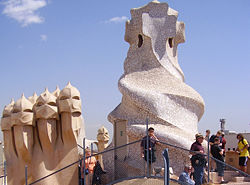
At his side, Arnau and Blay also worked closely related to architecture. Near his style is the Mallorcan Lawrence of Roussillon. Stairs and Renart represent the dreams and legends; Mani, a deformed expressionism; Smith, elegance linear ending in structuralism. Modernist painting was promoted primarily for your stay in Paris Rusiñol and houses. The first restored the literary sentimentality and vapor. The second, the curlicue refined, near Lautrec, and the theme of contemporary life.
We must distinguish the white wing of the modernist paintings (with figures such as LLimona Brull and John, Idealist of the curlicue as Riquer, Bonnin, Ford and Pascó) of the black wing and the "gang of saffron," chaired by the Isidro Nonell extraordinary. Nonell began with the curlicue of symbolist "cretins Boí," passed by the time the green, dark, of Gypsy, rich in nuances, and finished with a time of bright pink short time.
His arabesque came from Daumier, but near the Japanese that the curlicue implants Gose. The landscape of Mir, at the isolated spots, such as mosaics, is a modernist, but is tied in part to the late Impressionism common to Valencia Sorolla and Mongrell or Laureà Barrau. The mind rhetoric and dreamer modernism survived in the work of Hermen Anglada and Josep Maria Sert, brilliant designer of international activity. The poster had a wide dissemination and quality in this period.
Source: